Peptide profiler
Quick adme quote
Connect with us


Computer-Aided Drug Design (CADD) combines computational chemistry, AI- based analysis and predictions, molecular modeling and medicinal chemistry expertise to identify the compounds with the greatest potential for success, so you focus experimental effort where it has the biggest impact.
Whether you're facing low hit rates, difficult optimization decisions or challenges elucidating mechanisms of action, our scientists provide the insights needed to reduce risk, accelerate discovery and increase confidence at every stage of your program.
Drug discovery has never generated more data, yet success rates haven't kept pace.
Every unnecessary experiment drains time, budget and valuable program momentum. Many programs still struggle with the same underlying problems, regardless of target or modality:
Computer-Aided Drug Design lets you answer critical scientific questions before compounds ever enter the laboratory, reducing risk, cost and time-to-decision at every stage of your program.
From billions of possibilities to the right compounds, faster.
Rather than replacing experimental science, CADD helps focus it - fewer failed syntheses, faster hit identification, better candidate selection.
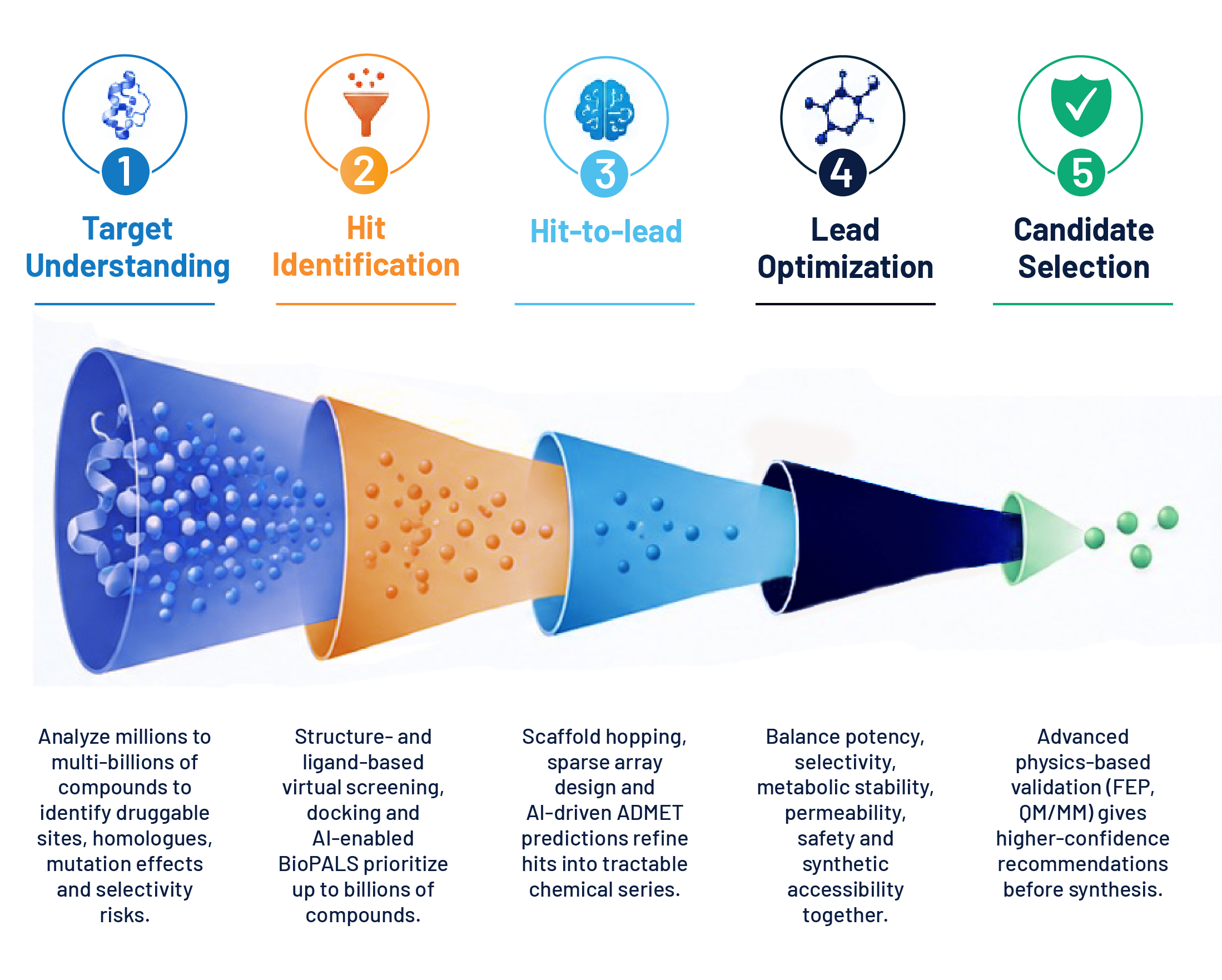
A program is only as good as its understanding of the biology. We analyze proteins, DNA and RNA using computational biology and bioinformatics at sequence, structure and phylogenetic level, helping you start discovery with greater confidence.
Searching millions, or even billions of molecules experimentally is just not practical. Using advanced virtual screening, molecular docking and our AI-enabled BioPALS platform, we rapidly prioritize compounds with the highest probability of success before laboratory testing begins.
BioPALS is our comprehensive, AI-powered hit identification platform. It goes beyond computational modelling alone — combining CADD, biological screening and ADMET profiling into a single integrated workflow to rapidly identify promising drug candidates without sacrificing accuracy.
Finding active compounds is only the beginning. Successful candidates also require the right selectivity, metabolic stability, permeability, safety, synthetic accessibility and patentability. We combine computational modeling with medicinal chemistry expertise to optimize multiple parameters simultaneously, reducing late-stage failures.
Understanding developability early prevents expensive downstream failures. Our predictive models evaluate the properties that matter most for clinical success, helping prioritize compounds with the highest likelihood of progressing.
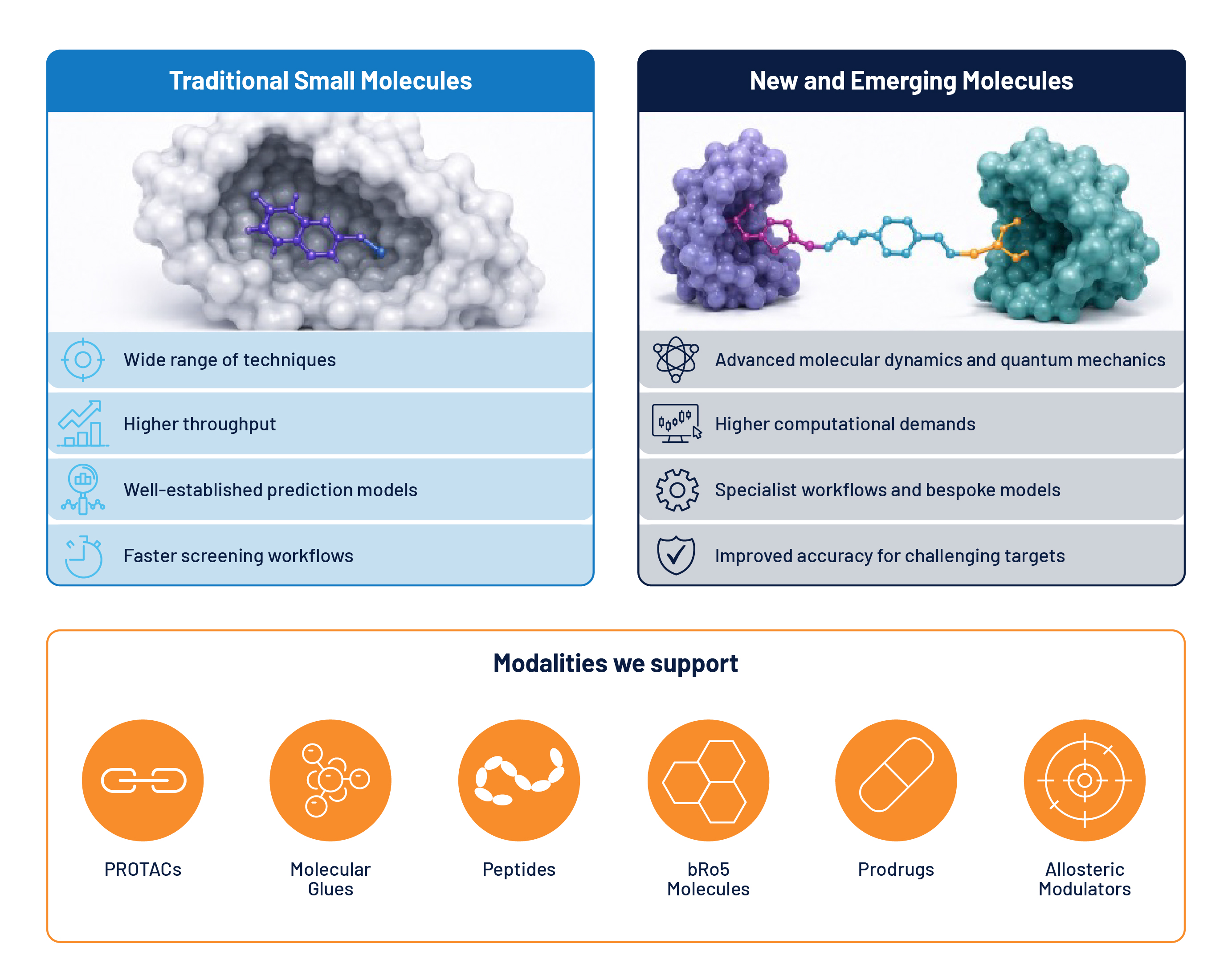
Many modern therapeutics fall outside traditional modelling approaches. Beyond-Rule-of-Five (bRo5) molecules and other challenging modalities demand advanced molecular dynamics, quantum mechanics and bespoke computational workflows rather than standard AI predictions alone.
Advanced modeling for todays most challenging drug classes:
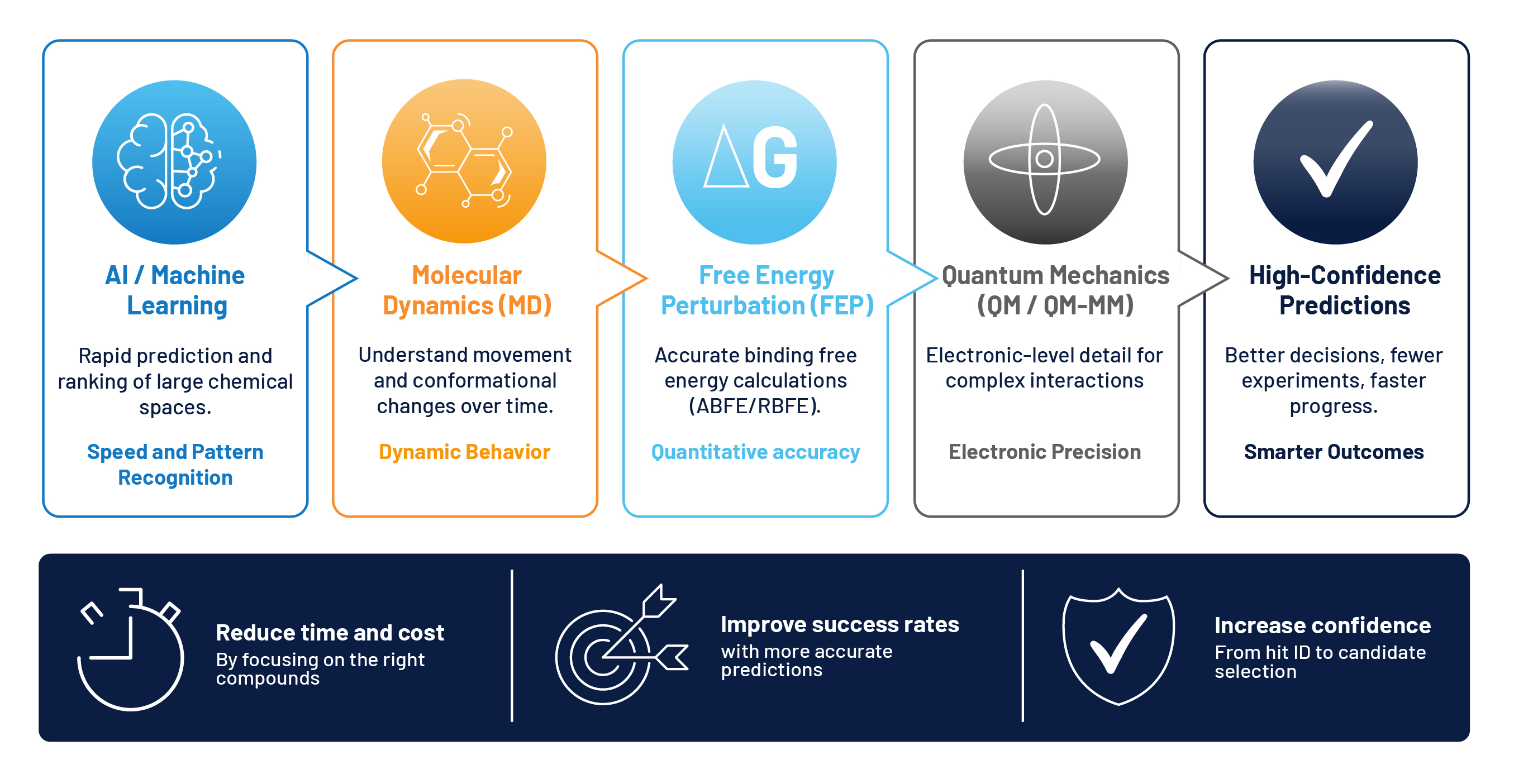
While AI can rapidly rank compounds, prediction quality depends on the underlying models. Our scientists combine AI with rigorous physics-based simulations delivering higher-confidence predictions for the most challenging drug discovery programs.
Scientific expertise that goes beyond software - Many organizations simply run software. We solve scientific problems. Every project is reviewed by experienced scientists who tailor computational strategies specifically for your program not generic workflows.
Multidisciplinary specialists - PhD computational chemists, medicinal chemists, structural biologists, bioinformaticians and AI specialists working as one team.
Secure, in-house HPC - Dedicated high-performance computing delivers complex simulations quickly, with complete control of your confidential data, no cloud SaaS platforms.
Integrated with the lab - Our CADD scientists work alongside medicinal chemistry, biology, ADME/DMPK, translational pharmacology and toxicology so insights directly influence experiments.
Strategic, not generic - We look at the big picture to deliver actionable recommendations, engineering custom computational models tailored to your project.
Platforms used include Schrödinger®, ORCA-WEASEL (FACCTs), GROMACS, DataWarrior, KNIME, SciFinder, Python, High-end CPU/GPU clusters.
A: Computer-Aided Drug Design uses computational techniques such as molecular modeling, AI and bioinformatics to predict how compounds interact with biological targets, helping accelerate drug discovery while reducing experimental cost.
A: Biotech companies, pharmaceutical organizations, and academic groups seeking to accelerate drug discovery through computational modeling and virtual screening.
A: The greatest value comes early during target validation, hit identification and lead optimization, where computational insights can guide synthesis and experimental design.
A: Yes. By prioritizing compounds with stronger predicted potency, selectivity and developability, CADD helps reduce the number of compounds that fail later in discovery.
A: AI-driven driven integrated hit identification platform that combines rapid virtual compound screening with biophysical laboratory validation and early ADMET profiling to deliver viable drug discovery hits for further development.
A: The Concept Life Sciences experienced team of computational chemists are empowered with high-end hardware and gold-standard software like Schrodinger. This allows us to rapidly build high-quality models and test complex scientific hypotheses, for leaner, more impactful drug discovery.
A: Yes. We have specialist expertise in modeling challenging modalities including PROTACs, peptides, molecular glues, covalent inhibitors and beyond Rule of Five molecules using advanced molecular dynamics and quantum mechanical simulations.
A: Yes. Predictive ADME/Tox modelling and multiparameter optimization (MPO) evaluate permeability, metabolic stability and toxicity risk — guiding compound design toward molecules with stronger drug-like profiles.
A: Projects typically begin with a scientific consultation to review the biological target, available data and project objectives. From there, our team designs a tailored computational strategy to support hit discovery, lead optimization or candidate selection.


